The IB Primary Years Programme (PYP) is a transdisciplinary curriculum framework that is inquiry-based and develops conceptual understanding. Each of these PYP elements are a result of the IB mission and are supported by educational research, expertise, and experience. The transdisciplinary nature of the PYP means that the disciplinary subjects are connected as teachers work together to produce coherent units of instruction.
Understanding Connecting Subjects to Create a Coherent PYP Curriculum
Primary Years Programme (PYP) educators engage in curriculum design with a goal of creating coherent, transdisciplinary learning. Designing units of instruction with this goal in mind requires teachers and coordinators to think about how to connect subjects in authentic ways using the curriculum framework. In this blog, we will explore what this collaborative and creative process entails.
Connecting Subjects to School Strategic Plan Goals
As we begin to explore creating a coherent PYP curriculum, let’s take a moment to consider a key point of a school’s context, the school’s strategic plan goals. Most schools have academic and socio-emotional goals and may have behavioral learning goals as well. Thinking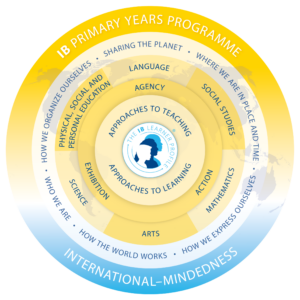 through the balancing of disciplinary and transdisciplinary teaching and learning in ways that maximize the learning potential of all students can be done effectively using the PYP framework and philosophy.
The IB philosophy beacons us to “develop inquiring, knowledgeable, and caring young people”. This phrase alone summarizes student outcomes that will require strategic, deliberate actions to address growth in content knowledge, communication, thinking, reflection, and social skills. The IB frameworks responds with approaches to teaching practices that include an inquiry approach and the use of concept-based teaching to increase knowledge, while wrapping the IB learner profile nurtured by explicit attention to approaches to learning (ATL) skills instruction around these approaches to teaching (ATT) to bring the mission to life. The disciplinary standards used to prepare curriculum whether they be from a state, national, or local source, possess conceptual understandings such as migration in the social sciences, change in the sciences, perspective in language arts, or relationship in mathematics. Additionally, these standards include the process skills that students will learn and apply such as distinguishing between, analyzing, interpreting, inferring, and composing. ATL skills instruction in the IB actualize a commitment to developing skills for learning. Not only do the academic process skills align with the ATL skills of the IB programmes, but they also cultivate the behavioral and collaboration skills that allow students to manage time, emotions and relationships to be successful in their school and personal life. The table below provides examples of the support that the PYP provides to academic targets.
| Academic Standard Example | IB Approaches to Learning Example (Explicitly taught) | IB Approaches to Teaching and IB Learner Profile Traits |
| Ask and answer questions to demonstrate understanding of a text, referring explicitly to the text as the basis for the answers. (CCSS.ELA-Literacy.RL.3.1) | Exchanging-information skills (listening, interpreting, speaking)
Critical-thinking skills (analyzing and evaluating issues and ideas) |
Knowledgeable, Thinker, Inquirer, Communicator
-based on inquiry -focused on conceptual understanding |
| Distinguish their own point of view from that of the narrator or those of the characters. (CCSS.ELA-Literacy.RL.3.6) | Critical-thinking skills (analyzing and evaluating issues and ideas)
Literacy skills (reading, writing and using language to gather and communicate information) |
Thinker, Reflective, Knowledgeable
-based on inquiry -focused on conceptual understanding |
| Determine the unknown whole number in a multiplication or division equation relating three whole numbers. (CCSS.Math.Content.3.OA.A.4) | Critical-thinking skills (analyzing and evaluating issues and ideas) | Thinker, Knowledgeable, Reflective
-based on inquiry -focused on conceptual understanding |
The mission also calls for developing young people “who help create a better and more peaceful world.” This call leads us to design curriculum that students can apply with intention, purpose, motivation, and care. Such a design again requires students to be able to communicate, research, think, collaborate, and use social skills to achieve. These same ATL skills and approaches to teaching are needed to facilitate academic progress at higher depth of knowledge (DOK) levels. As PYP teachers engage with the collaborative planning process for learning and teaching, they consider all the content they want students to learn and plan the best experiences to achieve within and outside of the Programme of Inquiry. With this thoughtful planning process, the PYP educators can support and enhance the academic and behavioral goals of the school’s strategic plan.
Connecting Subjects to Create a Coherency in Curriculum Objectives
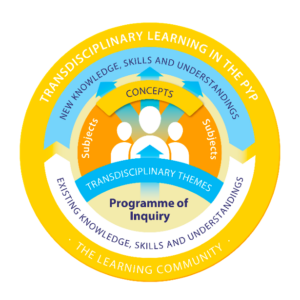 In the PYP, the subjects are connected so they can enhance learning. This enhancement of learning works to orchestrate coherent stories of understandings. The six subjects that make up the PYP subjects are language, mathematics, science, social studies, arts, and physical, social and personal education. The educators are provided a “themed storyboard” or unit planning guidelines to use to think through all the objectives from the subjects to find intersections that can come together into authentic learning experiences crafted into an engaging, significant and relevant unit of inquiry. The key to the intersection between the subject lies in the concepts or big ideas that they share. Each of the subject areas becomes a tool to contribute to the learning goals.
Every teacher acting as a curriculum designer gets to collaborate with their grade level, special areas, and all the grade level teachers to create their school’s unique coherent curriculum. Connecting disciplinary standards and objectives when possible and sensible while keeping disciplinary learning at play when it is best to do so, is collaborative work that PYP educators contemplate. The PYP curriculum process is an opportunity to discover how transdisciplinary and disciplinary learning can support one another. The process keeps the learner at the center of the curriculum at every step.
IB PYP Framework and Connected Subjects
The PYP framework is guided by a transdisciplinary approach to curriculum design where the disciplines are not distinguishable. We can compare this to the indistinguishability of the ingredients in a cake. The result of combining each part creates an even better, cohesive product. This approach brings about authenticity to teaching and learning. The connection between the subjects permits the learners’ curiosity to shape learning without being restricted by the disciplines. The transdisciplinary themes are used to organize inquiries to produce desired conceptual understandings.
The central idea of the unit of instruction provides the guideposts for learning goals, inquiries, the learner profile, and approaches to learning focus. Ultimately, this student-centered learning journey design has purpose behind it all. With lots of collaborative planning, all the subjects melt together to contribute to the central idea and subsequent inquiries pinpointed under each transdisciplinary theme. The series of these journeys from the first year of the school’s Primary Years Programme to the last is also carefully planned across the school using the Programme of Inquiry framework, which is the school’s IB continuum roadmap of learning that encapsulates the summary of the all the units, co-created, continuously reviewed, and collectively brought to life by the entire school community. Just as in the real world where science, social studies, the arts, mathematics, language, personal, social, and physical worlds most often intermingle in seamless experiences, the PYP authentically connects these subjects.
Professional Growth in Curriculum Design for All
PYP educators support for being curriculum designers that are confident in connecting the subjects into a coherent and impactful curriculum can be found in formal and information trainings. Professional learning that helps each educator understand how to use the subjects to create transdisciplinary learning empowers everyone to be appropriately prepared and informed. This preparation should allow PYP educators to engage in the collaborative planning process with certainty. The IB’s PYP Collaborative planning process for learning document points to the processes and questions that teachers will need to gain confidence in using in curriculum designing. Here are some tasks from the IB’s document that illustrate the type of work that expert professional learning can support. Teachers should be able to determine:
- Purpose and conceptual focus
- How to establish the unit’s learning goals
- What experiences will facilitate learning
- What evidence they will gather about students’ knowledge, conceptual understandings, and skills
- How their reflections will guide next steps in current and future learning and teaching
While considering each determination, educators continue to think through how to balance disciplinary and transdisciplinary learning. Having the opportunity to explore how to use this planning process to think through the subject areas’ standards and objectives over the course of a year with expert guidance is something that will benefit teachers and consequently the students through the learning experiences that come from reflective curriculum design.
Planning for Staff to Attend a Workshop
IB recommends that PYP teachers, coordinators, and leaders would benefit from the PYP Connecting Subjects to Create a Coherent PYP Curriculumworkshop. This workshop not only provides exploratory opportunities as professional development but also facilitates an understanding of the new subject guidance that must be implemented by September 2027.
Conclusion: Enhancing Your Coherent PYP Curriculum Journey with CASIE
Engaging with CASIE events and IB PYP workshops will prepare your staff with connecting subjects for a coherent PYP curriculum and implementation. Whether your staff are new to PYP or experienced, CASIE has the IB official workshop offerings to help your staff grow professionally in designing curriculum for maximum student learning. Additionally, CASIE has tailored consulting to meet the professional development needs for your unique context and schedule preferences. CASIE would be pleased to have you and your staff enhance their professional journeys at the workshops listed below, and more:
- PYP Category 1 – Building Your IB Programme
- PYP Category 1 – Head of School
- PYP Category 2 – Learning and Teaching for Conceptual Understanding
- PYP Category 2 – Exhibition
- PYP Category 3 – Connecting Subjects to Create a Coherent PYP Curriculum
- IB Category 3 – Approaches to Learning
- PYP Category 3 – Planning for Programme Evaluation
- PYP Category 3 – The Role of the Coordinator
Register for our upcoming, our upcoming PYP Connecting Subjects to Create a Coherent PYP Curriculum IB workshop, tailored consulting, other IB workshops, and events at our IB Workshops and CASIE Events webpages. If you have questions, please contact us at info@casieonline.org and we will be happy to assist.