Teachers as curriculum designers
The Middle Years Programme (MYP) has eight subject groups that are standalone courses designed to develop disciplinary and interdisciplinary understanding in students. The emphasis on interdisciplinary learning in the MYP makes it a distinguishing feature in the International Baccalaureate (IB) continuum.
Understanding what interdisciplinary teaching and learning involves, including its requirements, ways to organize it, and resources to support it, empowers educators to integrate disciplines in innovative ways. This helps students draw on knowledge from multiple fields to understand real-world problems and ideas, equipping them to take meaningful action to create a better world.
Understanding Interdisciplinary Teaching and Learning
AIMS Impact on Learning
MYP interdisciplinary units aim to curate knowledge from more than one discipline so students may develop deeper understandings. These multiple disciplinary learning experiences provide opportunities for students to inquire into and integrate varied perspectives such as using design processes with learning in the sciences to create possible theories, solutions, and products. Interdisciplinary learning experiences further students’ growth in becoming more open-minded by developing a mindset of connecting their knowledge from
different disciplines to innovate in a rapidly changing world. The connection between cultivating the IB learner profile traits of knowledgeable and open-minded to engagement in interdisciplinary learning is notable. By asking students to reflect on their learning using the descriptions of these IB Learner Profile traits one can further capture the value of these connections for staff, students, and the school, as well as also cultivating the reflective IB learner profile trait.
Objectives
The objectives of MYP interdisciplinary learning provide specific processes that students will be able to do as a result of the learning experiences. The three main processes are evaluating, synthesizing, and reflecting. Each main process is described further by pinpointing the tasks that students will engage in so as to be better prepared to face contextual and real-world issues as well as to create ideas at school and beyond. Looking deeper at the three processes, for the evaluating objective, students will have the opportunity to analyze their disciplinary knowledge and evaluate interdisciplinary perspectives. For synthesizing, they will have the chance to demonstrate interdisciplinary understanding through the creation of a product and express justification for how the product does so. When reflecting, learners will discuss the development of their interdisciplinary learning and how it equips and inspires them towards action.
More details of the specific learning targets for the three objectives are as
follows:
- Objective A: Evaluating engages students in “analyzing disciplinary knowledge” as well as “evaluating the interdisciplinary perspectives” to be able to respond to real-world and varied contextual issues and ideas.
- Objective B: Synthesizing involves students in product creation to communicate a purposeful interdisciplinary understanding and to “justify how their product communicates interdisciplinary understanding”
- Objective C: Reflecting allows students to “discuss the development of their own interdisciplinary understanding” and “how new interdisciplinary understanding enables action.”
Interdisciplinary Teaching and Learning
A major goal for MYP interdisciplinary teaching and learning is for it to be purposeful. The concepts from two or more disciplines are integrated together towards the determined purpose. The general purpose is student-centered in nature, seeking for learners to gain a deeper understanding of and competence in navigating the world. The process of designing interdisciplinary learning requires an intentional purpose that is clearly communicated to avoid artificial connections and incoherent learning.
Interdisciplinary teaching and learning is grounded in the disciplines. The educators use the curriculum designing process to reorganize the selected objectives from the disciplines in purposeful, connected ways while honoring the MYP subject groups.
Interdisciplinary teaching and learning planning is integrative. The goal here is to develop learning experiences where teachers and students integrate disciplinary perspectives. These perspectives are thoughtfully brought together through a summative assessment task. When possible, these assessments should be designed to address multiple objectives.
Integrated courses
MYP acknowledges integrated courses. These courses exist within a subject group to combine knowledge from multiple disciplines over time using a holistic approach. Subject-group guides provide information on this topic. This table shows the formally designated integrated courses:

Planning Interdisciplinary units
The MYP describes interdisciplinary curriculum design as a continuum of learning experiences that consists of borrowing from other disciplines, developing interdisciplinary connections, and creating full interdisciplinary units.
Borrowing from other disciplines involves educators collaborating to incorporate knowledge, concepts, and skills from one field into another in order to deepen students’ understanding. In this process, educators intentionally identify natural connections between their subject area and adjacent disciplines.
Weaving an integrating interdisciplinary thread throughout the year of a disciplinary course is another lens used in planning. An example might be an individual and societies teacher and art teacher collaborating to highlight artwork and artifacts of various cultures and time periods in each unit.
Creating formal interdisciplinary units involves an interdisciplinary approach. Collaborative planning time is a hallmark of these co-planned units. The IB’s Programme Resource Centre houses two variations of unit planners that can be used to guide and document the learning purposes, processes, and other key details of the learning experiences during the collaboration planning processes.
First Steps in Interdisciplinary Planning
There are various possible points of entry to interdisciplinary planning. Teachers can begin designing a unit around a local, global, community-based, or interpersonal challenge. These types of problems naturally require the knowledge and skills from more than one discipline to solve. Specified concepts can also be considered to find common and complimentary ground between disciplinary knowledge. Global contexts also accommodate multidisciplinary learning experiences. A multidisciplinary approach can usher
in a variety of perspectives for concepts which in turn deepen conceptual understanding. Real-world issues provoke students to integrate thinking across more than one discipline as well.
Collaborative Planning Process Considerations
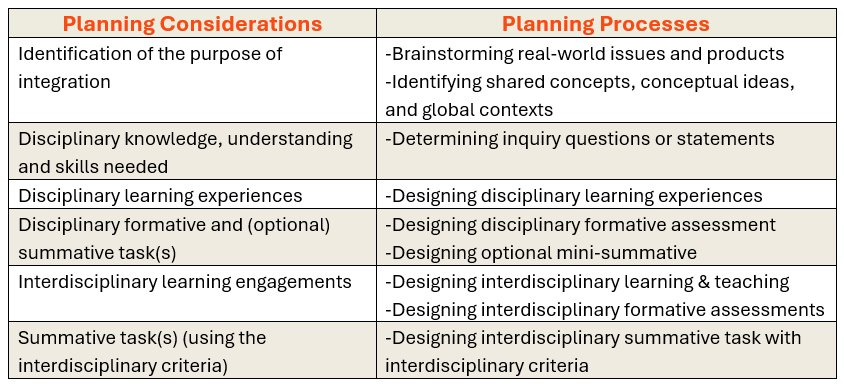
Designing meaningful interdisciplinary units demands careful considerations when planning. The table below includes the MYP’s considerations and correlating processes as indicated in the Interdisciplinary Teaching and Learning in the MYP document.
Requirements
There are two MYP requirements for interdisciplinary teaching and learning. According to the Interdisciplinary Teaching and Learning in the MYP, the first is that schools must engage “students in at least one collaboratively planned interdisciplinary unit that involves at least two disciplines either from the same subject group or from two different subject groups.” The second is that “in each year of the programme, schools must address all three objectives (every strand) of interdisciplinary learning at least once per year.”
Conclusion: Enhancing Your Approaches to Learning Journey with CASIE
Engaging with CASIE events, IB workshops, and services can enhance your implementation of MYP interdisciplinary teaching and learning. Register for our upcoming, in-person or virtual MYP Interdisciplinary Teaching and Learning IB workshop, tailored consulting, other IB workshops, and events at our IB Workshops and CASIE Events webpages. If you have questions, please contact us at info@casieonline.org and we will be happy to assist.