Some courses teach students what to think. Theory of Knowledge teaches them how. At the heart of the IB Diploma Programme, TOK sparks something exciting and rare in a classroom: genuine curiosity, shared between teacher and student, about the nature of knowledge itself. It is challenging, thought-provoking, and for those who embrace it, deeply rewarding for student and teacher alike.
Theory of Knowledge sits at the center of the DiplomaProgramme matrix, and, because it teaches critical thinking, reflection, and acknowledgement of multiple perspectives, it is one of the most important classes a high school student can take. It forces students to grapple with ambiguity and uncertainty and functions as the culmination of the DP learners’ educational journey.
What is Theory of Knowledge?
Theory of Knowledge (TOK) is one of the three core components of the IB Diploma Programme, along with the Extended Essay (EE) and Creativity, Activity, and Service (CAS) requirements. Placed in the core of the DP matrix, TOK acts as the academic hub that connects the entire curriculum, prompting students to step back from their individual subject classes and examine the nature of knowledge itself. For educators, this can be seen as a gift. Instead of delivering content, TOK teachers get step back, dig in, and explore the questions that many classrooms don’t have time or space for.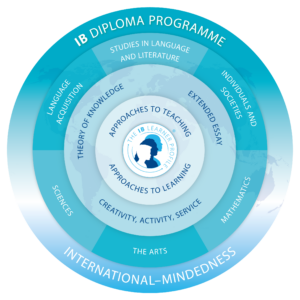
According to the TOK Subject Guide, “the main focus of TOK is not on students acquiring new knowledge but on helping students to reflect on, and put into perspective, what they already know”. By exploring how knowledge is constructed and justified across disciplines, TOK helps students make meaningful connections between their DP courses. Throughout this process, students learn to challenge their assumptions, question their beliefs, articulate their worldviews, and mature into critical, reflective thinkers.
Theory of Knowledge in the IB Diploma Programme
What distinguishes TOK from other DP core components is its 100-hour teaching requirement over the two-year Diploma Programme, which means schools must allocate dedicated class periods for it rather than treating it as independent work. It consists of two assessments: an exhibition, which is internally assessed and worth 33% of the final TOK grade, and a essay, up to 1600 words, which is externally assessed and worth 67% of the final TOK grade. The culmination of these two assessments will earn a student a final grade from A through E, very much like the Extended Essay.
Students can earn up to three diploma points based on their combined TOK and Extended Essay performance, as shown on the table below, obtained from the IB’s DP Passing Criteria page. Note that an E grade in either TOK or the EE disqualifies a student from earning a DP diploma, even if all other DP requirements have been met. 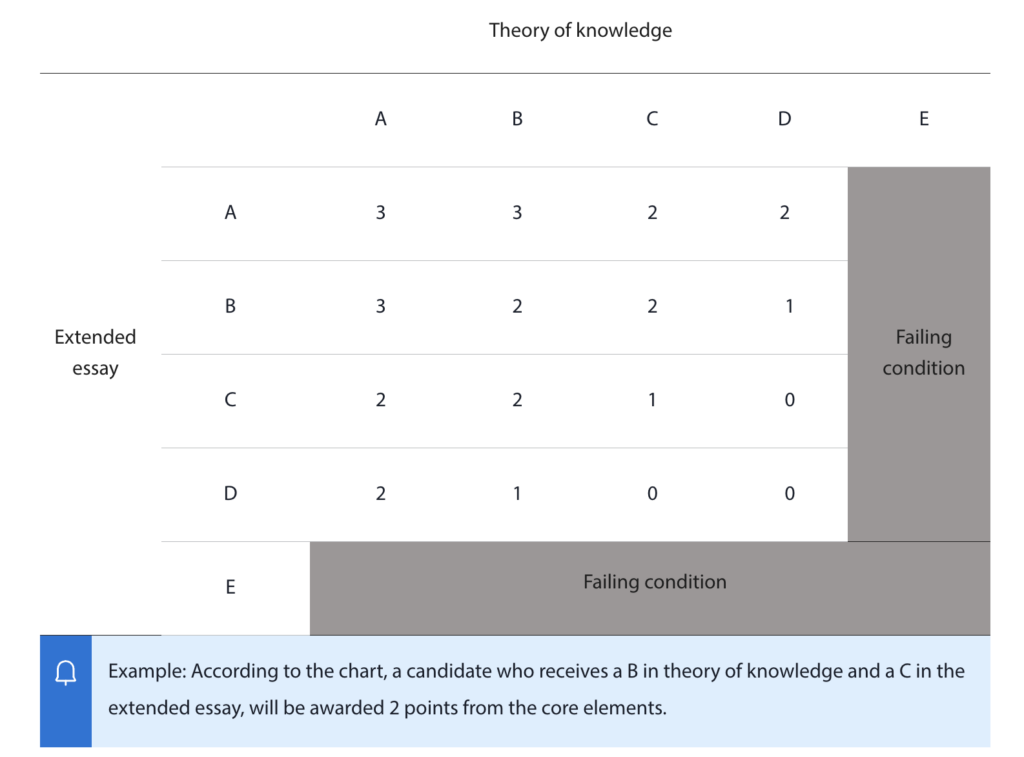
Curriculum Overview
Course Aims
The aims of the TOK course highlight its unique role in the Diploma Programme: rather than acquiring new knowledge, students reflect on and put into perspective what they already know. TOK encourages students to ask the central question “How do we know that?” while exposing them to ambiguity, uncertainty, and questions without definitive answers. For educators who are drawn to questions about context and justification, TOK feels less like a curriculum to deliver and more like an intellectual journey.
That same spirit of inquiry shapes the experience for students as well. The course equips them to navigate complex questions by making them aware of their own perspectives and limitations. It prompts critical reflection on their personal beliefs and assumptions. By engaging with diverse cultural perspectives and examining knowledge claims from multiple angles, students develop open-mindedness and learn to appreciate how different communities construct and value knowledge. Students also make connections across academic disciplines by exploring underlying concepts and comparing methods of inquiry used in different Areas of Knowledge. Ultimately, TOK prompts students to consider the values, responsibilities and ethical concerns that arise in the production of knowledge, along with how knowledge is acquired, applied, and communicated.
Course Components
The TOK course has six interconnected components, each playing a role in shaping how students learn to think about knowledge:

Knowledge Questions
Themes
Areas of Knowledge
The Knowledge Framework
12 TOK Concepts
Assessment
TOK revolves around knowledge questions, which direct students away from subject-specific thinking and into TOK territory.
The course itself is structured around two core elements: Themes and Areas of Knowledge, which provide lenses to explore how different disciplines build and examine knowledge.
A Knowledge Framework, which is a series of questions designed to deepen thinking, is provided for each theme and AOK.
The 12 concepts are intended to give the students terminology and a consistent vocabulary to use as they think about and discuss knowledge.
Two assessments are required to illustrate students’ thinking: the Exhibition, in which they connect real-world objects to knowledge questions, and the TOK Essay, in which they construct an argument in response to an IB prescribed title.
Together, these six components, each discussed in more detail below, provide a structure and scaffold to teach students to think critically, synthesize knowledge across disciplines, and contemplate what we know and how we know it.
Knowledge Questions
Knowledge Questions sit at the core of the TOK curriculum. These questions are not subject-specific; instead, they require students to step back and examine how knowledge is produced, acquired, shared, and used. Knowledge questions have multiple plausible answers.
| Subject specific situation/question | → | Knowledge question |
| A journal article detailing the outcomes of a medical trial of an experimental new drug | → | What ethical constraints should there be on the pursuit of knowledge? |
| Watching a video of a talk on compassion, happiness, and inner peace by the Dalai Lama | → | Does some knowledge only belong to particular communities of knowers? |
Knowledge questions are about knowledge, contestable, and draw on TOK concepts. These questions help students move beyond subject specific questions and into TOK discussions that are focused on the nature of knowledge itself.
Themes
TOK is built around two main course elements – Themes and Areas of Knowledge. These elements work together to help students explore how we develop our understanding.
Students are required to engage in one core theme, Knowledge and the Knower, that centers their personal exploration and establishes a starting point for inquiry. Teachers then select two optional themes to extend that inquiry into more specific contexts.
When selecting optional themes, teachers should choose topics that align with their own expertise or resonate with their students’ experiences and school culture. It is also useful to consider interdisciplinary links: STEM students may engage more readily with knowledge and technology, while humanities students may be drawn to politics or language. This element of choice is one of the most rewarding and exciting parts of designing a TOK course because teachers are invited to bring their own passions into the room.
Core Theme (Required)
- Knowledge and the knower: Students reflect on themselves as knowers and thinkers, and explore the different communities of knowers to which they belong.
Optional Themes (Choose 2 of 5)
- Knowledge and technology
- Knowledge and language
- Knowledge and politics
- Knowledge and religion
- Knowledge and indigenous societies
Areas of Knowledge
The areas of knowledge (AOK) are specific branches of knowledge, each with their own distinct nature and methods of gaining knowledge. Students are required to examine all five Areas of Knowledge in order to understand how different disciplines generate and justify knowledge. The IB recommends a minimum of 32 teaching hours to themes, and 50 hours to Areas of Knowledge.
Areas of Knowledge (All 5 Required)
- History
- The human sciences
- The natural sciences
- The arts
- Mathematics
Teachers have flexibility in how they allocate instructional time to AOKs, choosing to teach them in isolation, in combination with one another, or integrated into the TOK themes.
The Knowledge Framework
Built into the course is a series of “knowledge frameworks” which are designed to help teachers and students explore the themes and AOKs. Detailed in the TOK guide, the knowledge framework provides example knowledge questions for each theme and Area of Knowledge (AOK). This framework consists of four common elements:
- Scope: Explores the nature, purpose, and limitations of a specific discipline
- Perspectives: Focuses on how viewpoints and context shape our understanding of knowledge
- Methods and tools: Investigates the actual processes used to produce, validate, and build knowledge
- Ethics: Explores the moral responsibilities and ethical implications behind producing and applying knowledge
This framework and its guiding questions foster a focused exploration of each theme and AOK. Utilizing common elements throughout the curriculum helps unify the course and guides students to make meaningful comparisons and connections across TOK. This approach helps students discover where disciplines align and where they differ. Far from being a rigid constraint, the knowledge framework gives teachers a creative scaffold and opens up possibilities for lesson design across every discipline. The TOK guide delineates a series of questions for each theme and area of knowledge.
12 TOK Concepts
Every discipline has its own vocabulary, a shared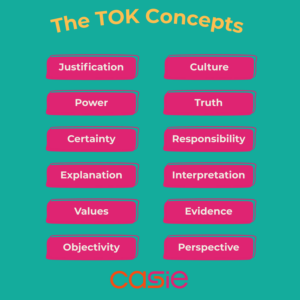 language that allows practitioners to communicate with precision and think with clarity. TOK is no different. Twelve concepts thread throughout the course: evidence, certainty, truth, interpretation, power, justification, explanation, objectivity, perspective, culture, values, and responsibility. These concepts serve as thinking tools, giving students a common language for examining knowledge questions across each theme and AOK. By returning to this terminology again and again in classroom discussions and activities, students not only deepen their understanding of TOK but also develop the ability to transfer that thinking to new and unfamiliar contexts. For teachers, infusing his vocabulary into everyday classroom interactions is one of the most effective ways to build a meaningful TOK culture, one where the language of inquiry shapes how students engage with ideas.
Assessment in TOK
Students are required to complete two assessment tasks for TOK. The Theory of Knowledge exhibition is worth 33% of the total TOK score. It is internally assessed and externally moderated. The Theory of Knowledge essay on a prescribed title is externally assessed and worth 67% of the total TOK score.
Assessment Objectives:
Having completed the TOK course, students should be able to:
- demonstrate TOK thinking through the critical examination of knowledge questions
- identify and explore links between knowledge questions and the world around us
- identify and explore links between knowledge questions and areas of knowledge
- develop relevant, clear and coherent arguments
- use examples and evidence effectively to support a discussion
- demonstrate awareness and evaluation of different points of view
- consider the implications of arguments and conclusions
How TOK is Graded:
TOK is assessed through two components that combine into a total score out of 30, which is then converted to a letter grade from A to E.
The Two Components
The TOK Exhibition is internally assessed by the teacher, moderated by the IB, and worth 10 points.
The TOK Essay is externally assessed by an IB examiner and worth 10 points. Because the essay carries twice the weight, the final score is calculated as follows:
Total TOK Score = Exhibition Score (0–10) + (Essay Score (0–10) x 2)
Grade Boundaries
Once a student’s total TOK score out of 30 is calculated, grade boundaries determine how that number translates into a final letter grade from A to E. Rather than setting fixed score ranges in advance, the IB establishes these boundaries each year after all student work has been marked. This ensures that the conversion from number to letter grade reflects actual student performance across that exam session, rather than a predetermined curve.
The Exhibition
The TOK Exhibition Task
The TOK exhibition is weighted 33% of the students total score in TOK. Completed prior to the essay, students are required to create an exhibition of three objects with accompanying commentaries that explores how TOK manifests in the world around us. Students are provided 35 prompts. Their task is to choose one prompt, select three real-world objects, and write a 950 word commentary explaining how each object connects to the chosen prompt.
Students are encouraged to choose objects that are of personal interest to them and it is strongly recommended that students base their exhibition on one of the themes studied in their TOK course.
Teachers are permitted to provide feedback on one draft of this work. In addition, teachers are required to provide all students with an opportunity for their completed exhibitions to be showcased and exhibited to an audience.
Here is a sample of the prompts:
- To what extent is certainty attainable?
- What counts as good evidence for a claim?
- Why do we seek knowledge?
- What role do experts play in influencing our consumption or acquisition of knowledge?
The TOK Exhhibition Assessment
The TOK exhibition is an internal assessment– it is marked by the teacher and then externally moderated by the IB. Graded on a single 10-point holistic rubric, the exhibition is focused on the central question: How does TOK manifest in the world around us. It is important to execute these four tasks for each object:
- Identify the object’s relevance: Be specific rather than generic and provide its real-world context
- Link to the prompt: Explicitly explain how the object connects to the prompt
- Justification: Provide a well-reasoned argument for why each object is valuable to the exhibition and how it answers the chosen prompt.
- Evidence: Support all claims with clear, appropriate references to the chosen prompt
The TOK exhibition is beneficial and rewarding because it grounds abstract concepts in everyday life by challenging students to answer real world prompts using evidence from their own experiences.
The TOK Essay
The TOK Essay Task
The TOK essay is externally moderated and weighted 67% of the students total score in TOK. Students are required to write an essay in response to one of the six prescribed titles, released in November and May of each year, for their school’s examination session. The maximum word count for the essay is 1,600 words. Specific sources should be used and cited appropriately.
Teachers are required to have three formal recorded interactions with the student, which must be recorded on the TOK essay Planning and Progress Form (TK/PPF).
- Discuss the list of prescribed titles with the students.
- Discuss the students initial exploration of their chosen title, or essay plan.
- Provide comments on one draft to the student’s essay.
Here are the a few prescribed titles from previous examination sessions:
- For historians and artists, do conventions limit or expand their ability to produce knowledge? Discuss with reference to history and the arts.
- What is the relationship between knowing and understanding? Discuss with reference to two areas of knowledge.
- Should knowledge in an area of knowledge be pursued for its own sake rather than for its potential application? Discuss with reference to mathematics and one other area of knowledge.
The TOK Essay Assessment
The TOK essay is graded on a single 10-point holistic rubric focused on the central question: Does the student provide a clear, coherent and critical explanation of the essay title. It is important to demonstrate the following skills in the essay:
- Making links to AoKs: effectively connect the discussion to at least two AoKs, using specific terminology to analyze how we know what we claim to know. This is a good place to utilize the concepts.
- Offering an effective argument: Arguments must be logical, coherent, and supported by specific examples.
- Understanding perspectives: Demonstrate a clear awareness of alternative viewpoints, assessing them rather than simply stating them.
- Use specific examples: Support all arguments with specific, real-world examples.
- Maintain a sustained focus: The entire essay should stay focused on the prescribed title.
- Consider Implications: Explore the consequences or broader significance of the arguments presented in the essay.
The TOK essay is beneficial and rewarding because it develops lifelong critical thinking skills, encourages multiple perspectives, fosters self-awareness and a questioning spirit, synthesizes student thinking, and draws connections between concepts and ideas.
Assessment Examples:
One way to prepare students for TOK assessment is to show them what it looks like in practice. The IB makes this possible by publishing a repository of real exhibition submissions and TOK essays. Walking through exhibition submissions and TOK essays, both strong and weak, gives students a concrete sense of the standard they are working toward. Strong exemplars show students what precise knowledge claims and effective argumentation look like while lower-scoring examples are equally powerful, revealing the pitfalls of surface-level thinking. Teachers are encouraged to build exemplar review into the course, modeling what good thinking and writing look like.
Who teaches TOK?
Because TOK doesn’t belong to any single discipline, neither does the TOK teacher. While the course shares common ground with philosophy, TOK is not intended to be a philosophy course, and there is no expectation that TOK teachers have any academic or teaching background in philosophy. In fact, teachers from any subject area can bring a rich and unique perspective to the TOK classroom. What matters most is a willingness to sit with open-ended questions and model the kind of reflective thinking the course demands. A 2015 study published by the IBO suggests that teaching TOK was a valuable professional development development experience for educators, enhancing their own critical thinking and deepening their interdisciplinary understanding.
For experienced or novice teachers, CASIE offers category 1, 2, and 3 workshops, ensuring that every educator, regardless of background, has the tools and training to guide students through this course. Ultimately, the best TOK teachers are not those with all the answers, but those who are genuinely curious about the questions, and exploring these questions with their students.
Conclusion: The role of TOK creating global citizens
Theory of Knowledge is more than an IB DP requirement. It is one of the most meaningful experiences the IB Diploma Programme has to offer, for students and teachers alike. By delving into the nature of knowledge and questioning how we understand the world, TOK fosters critical thinking, open-mindedness, skill development, and global awareness, preparing students to face the complexities of the modern world and become responsible, thoughtful, and well-informed global citizens. It equips students with the skills necessary for academic success, including research, analysis, and effective communication, while also challenging them to look inward and examine their own assumptions, beliefs, and perspectives. For teachers, the rewards are just as real. TOK classes create an environment where students are asked to think about why they know what they know and where that knowledge comes from. It is a kind of teaching that is energizing and transforms the classroom from a place of answers into a place of inquiry. It sends students out into the world not just with knowledge, but with the wisdom to question it. It is a journey worth taking!
Ready to bring TOK to life in your classroom? CASIE offers IB DP Workshops, tailored consulting and capacity building professional development to support your school at every stage of the TOK journey, ensuring continuous and purposeful DP programme development.